Yonim: My Nephew’s Unique Way of Exploring Difficult Cultural Histories
I feel scared to share my personal perceptions of the conflict in Gaza and Israel. Yet I've decided, at least for myself, that even without being an expert, it’s important to examine, and ultimately share my stance on difficult issues shaping the human story.
I have felt heartbreak, terror, rage, sadness, grief, hope, and helplessness. As a Jew and a scientist, I see many patterns in the history of this conflict, but I don’t always know the right lesson to draw. Both Palestinians and Jews have had horrific suffering and been responsible for each other's suffering in many cases. Too often, in my view, people fail to distinguish modern extremist politics from historical cultural conflict. There is xenophobia, but also nationalism, deep convictions, and self-interest. And of course there is love and caring, cross-cultural bridging, courage of the heart that sometimes gets overshadowed.
What finally moved me to write is the memory of my nephew, Yonim—his name means “doves” in Hebrew. He embodied curiosity, creativity, and connection, drawing people out with music, poetry, playfulness, and honesty. My family was devastated when he died in an accident on his 21st birthday. He was reverent of life without needing to think about it. His spirit modeled how to choose curiosity over certainty, connection over righteousness.
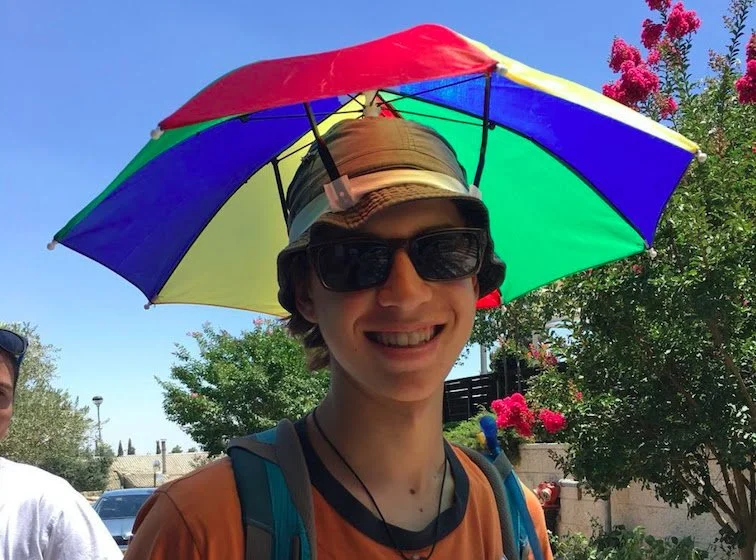
This post is not only about him, but about us, our responsibility to question our certainties, remain open, independent, and inclusive. Sting once wrote, “There is no political solution.” Real change begins when our hearts, not just our grievances, become the source of our words. And for Yonim, it was often silliness, not sadness, that came from his heart, irreverence and nonsense, laughter, and adventure.
We can get personal
On Labor Day weekend, I was barbecuing in my driveway when my neighbor walked by and commented that it smelled good. He is a younger man, with a different background, and a different culture. When I finished cooking, I knocked on his door. He answered in his skinnies, and I gave him a piece of barbecue. After a couple of years of living together, this is the most that has been said between us.
We may not share political views, but now we share friendship. That bond goes beyond the narratives that divide us.
This is the kind of thing Yonim did. Our conceptions limit people, but friendship creates possibility.
“I'm sure you didn't mean…?”
What has kept me quiet on Gaza and Israel is a vague awareness that I don’t have the words, that nobody has the words, to understand what's occurring in our midst.
When I wrote a post in the form of a question trying to understand the context of the situation in the Middle East more fully— not that I didn't have any context, mind you, but I am aware that my context is limited— I received a response from a well-meaning elder, in the form of, “I'm sure you didn't mean…”
He was actually right, and I'm partially glad he clarified what I was trying to say.
But I was left with an unpleasant taste in my mouth: what was I not allowed to say? I wasn't sure. It's not that I don't have any information or any context. It's that his perception of what's okay is different from, say, my father-in-law (who is quite secular), or my step-brother (who is Orthodox). In Judaism, as in a number of other sensitive topics, I find myself trying to guess what each person is expecting to hear.
My elder and friend laid out the facts and the history with an aura of impartial expertise, according to his own explanation. I did not feel encouraged to ask more questions.
Does crisis open us up or shut us down?
Back in 2020, during the COVID pandemic, I remember the feeling of shock, when, in the midst of this tremendous upheaval, the underlying drumbeat was familiar, “I'm sure you didn't mean…”
I'm sure you didn't mean I have to wear a mask…
I'm sure you didn't mean vaccines can be dangerous…
I'm sure you didn't mean we should open our schools before it's safe…
I'm sure you didn't mean we should shut down our businesses and sources of income…
How is it possible that, faced with crisis after crisis, people get no less certain about their understanding of the circumstances?
In 2008, the economy crashed because of speculative housing investments. It turned out to be another opportunity for people to entrench themselves in their position. Progressives saying we must occupy the cities and take back civic control, and conservatives finding ways to blame the government and a new Black president for what was clearly a systemic failure of incentives; the natural destiny of a financial system based on self-reinforcing self-interest; a creation presided over typically by men—white, affluent and old.
Years after the invasion of Iraq and the heat of passion subsided, people finally, collectively, acknowledged the overzealous rush to war based on false pretenses of weapons of mass destruction. At the time, the US Representative from Oakland, Barbara Lee, was the only person in the US Government to vote ‘no’ on legislation that streamlined perpetual warfare:
“However difficult this vote may be, some of us must urge the use of restraint. Our country is in a state of mourning. Some of us must say, let's step back for a moment. Let's just pause, just for a minute and think through the implications of our actions today, so that this does not spiral out of control.”
Now that everybody was on the same page about the fictional weapons of mass destruction, I thought for sure that people would finally say, “Wow! We really don't get it. We were so wrong. Why do we keep screwing this up?”
But that reconciliation didn't come. Representative Lee, to my knowledge, was never culturally acknowledged for her foresight, and no honest contrition was made by those who were fooled by their own passions. It goes straight back to my hero, physicist Richard Feynman, who said “You must not fool yourself, and you are the easiest one to fool.”
It's what makes me cringe about the place I grew up, Marin County California, a wealthy, liberal outpost. I'll take responsibility for some of my personal feelings of hurt, feeling disregarded and invisible, that are my own responsibility.
What bothers me on an impersonal level is that we are a community that has fully embraced the Green Revolution, and we fight vigorously to address climate change on a national and international level and even locally, but we don't have a truly useful public transit system. Sure, we have decent buses, but we're not connected to the light rail system of the greater Bay Area (by popular vote) and for the vast majority of us, the inconvenient bus system is simply a backup if our car breaks down. Marin County remains mostly populated by financially comfortable white people, or working class Latino folks, even though it proclaims equity. I still consider it home; it's part of me and I'm part of it, but it's a contradiction.
It's the same underlying drum beat, “I'm sure you can't mean…”
I'm sure you can't mean my property values might fluctuate?
It's reflected in how we take to the streets to protest against authoritarianism, organizing highly structured grassroots efforts, with protest permits and all, to stand near (but not block) traffic and get drivers to honk their horns, but go home at night to watch Rachel Maddow instead of knocking on doors and getting out the vote. As I've tried to be more involved with those groups, they seem already set on their direction and their leadership, “We've got it under control.”
It's reflected in the budget negotiations in my school district, where both sides are deeply entrenched, but I've discovered that neither understands the full picture of the data. The Union seems to have given up trying to track the financial shell game controlled by the school district’s accountants, and the district personnel are placed in a position of authority but with limited perspective. We are told, “School budgets are very complicated, (you wouldn't understand).” Yet when I dug in and started tracking the statements being made at the school board meetings, I noticed an inconsistency in the arguments of both the Union and the district. When I pointed it out, I was told, to my horror, “Thank you, I never realized that before.”
Are we learning what we need to learn from situations?
In a weird way, it seems paternal (whether or not there are men involved).
Every time a crisis passes us, I look up to see the same response to circumstances against which we are helpless: “We've got it under control. We know what to do.” And yet, mask mandates have created a vehement whiplash. Carbon tax proposals and movements for social investing have entrenched people in their positions.
What we need to take away from these continued crises may not be some idea that our solutions aren't good enough and if we just had the right solution, the right policy, the right political angle (which is invariably the one that seems obvious to me), then things would be better. Rather, what we may need to take away is an almost crippling realization that we simply don't know. What we understand is not sufficient. We are limited in our perspective, and what we don't know might also invalidate our certainty of what is right.
What does physics say?
Perhaps polarization is the very thing driving me to study society rather than physics. As I began to understand physics as a working professional, I realized the physics community itself is polarized. The polarization isn’t about evidence, or coherence of a model, it is about beliefs, personal style, hidden biases, feelings, and the particular perspective one takes on one's field.
For physicists who don’t believe my most outside the box musings, don't believe in synchronicity or God or meaning or fate or destiny or consciousness, I’m not going to change their minds. But it's not just me and my somewhat outside of mainstream views. Within mainstream physics there's tremendous disagreement and even disrespect and disdain between those who interpret modern physics as philosophical and those who are committed to a material perspective. These two factions do not get along.
We as humans can sometimes get fixed on our beliefs. It’s tempting to be very sure of what we are sure of.
We see the world a certain way— physicists included—based upon our upbringing, how it aligns with our personal view of relationships, and the meaning of life. We gravitate towards the theory that reflects our beliefs about life, rather than the one that adjusts our beliefs.
One would think something as concrete as physics would have something clear to offer on the question of polarization. But Einstein knew better. When offered the presidency of Israel at its formation, he quickly declined, admitting that people are much more difficult than physics! In fact I worry that many people on the political Right experience science and logic as domineering forces because they can create such a sense of certainty among those on the political Left.
I find it personally discouraging to come up with new ideas in a field, only to realize that sometimes polarization, personality, and preconceptions may be determining how it is received more than the actual physics itself.
I’m not saying people should be open to anything. It’s a skill to realize where in life you tend to be close minded. In my experience, there's a point in every conversation where we can instinctively turn away from someone, or turn towards them. It's not a question of suffering fools, it's a question of understanding our own blind spots. When physicist graduate student Hugh Everett III discussed his PhD thesis on the many worlds interpretation of quantum mechanics with Niels Bohr, an icon in the field, he was dismissed as not understanding quantum mechanics. Yet 70 years later, Everett’s theory is one of three surviving major interpretations of quantum mechanics. Indeed, it was the great Bohr (a hero of mine, too!) who didn't understand quantum mechanics, but unfortunately, the brilliant Everett never recovered professionally: he left physics, had a career in industry, and struggled with alcoholism. These kids described him as withdrawn and broken.
A century earlier, the British physicist Lord Raleigh claimed that all of physics was understood conceptually, and the rest was working out detailed calculations. Then at the turn of the century, vast new fields of physics were born, quantum mechanics and relativity. Most of what Lord Raleigh knew as physics in his day was a special case of these new, more general modern fields of physics.
Kids have a natural knack for deep listening
Yet how can we blame him? Are we not all pretty certain about what we're certain of?
Being open to new ideas might just mean listening without correcting. Every situation can be a path to some kind of gift, if you see what is there to be received.
These are the kind of imperfect gifts that my nephew Yonim thrived on. He didn’t need resolution; when faced with polarities, he had a knack for squirming out the side. Art and poetry spoke a nonpolarizing language for him.
If life is like art, based more on personality than truth, it has led me to search for that perfect sidestep, the way to recognize polarization as it's coming and move outside of its path so it doesn't trap me in black and white thinking. Listening to life, and listening to God or the soul, also means listening to other people. These are the moments when I hear myself saying, “I'm sure you can't mean…”
“I'm sure you can't mean I'm acting like my dad…”
“I'm sure you can't mean you don't care about going to college…”
These are the moments I need to listen better.
I'm chuckling to myself because you would be hard-pressed when visiting my classroom of 30+ teenagers to say that they are good listeners. My chief complaint of teaching is that my students talk when they shouldn't, interrupting mindlessly. My main struggle is to maintain their attention long enough to guide them to some useful insight.
But for all of this, they are really good listeners. They hear me. They hear each other.
I'm picturing Elijah, who wears similar orange shoes to mine, and is in the back of the room on his feet animatedly gesticulating to his friends about some passionate and urgent thought; and then when he catches my eye and realizes I'm trying to get his group’s attention, says with full sincerity and innocence, “Okay, come on guys, we got to focus, Mr. Nelson's talking,” and he adjusts his body and sits down in his stool, fidgeting, eyes up front again and ready to learn.
I'm picturing my own daughter last night, when I said just one sentence to her: “I'm feeling mad that you haven't made progress on finding a job or studying for the SAT, but you have social plans tonight and all weekend and you're hosting your first party next weekend.” She played with the cat as I talked, making occasional eye contact with me, and when I was done, mouthed the words “But I love you…”
I told her that was all I wanted to say, and she went back to her room to do her own thing. An hour later she came out for dinner, and I was exhausted lying on the couch. I overheard her say to Dana, “...and I've been working on looking for jobs because I really should be and I feel bad.”
Kids listen. We can learn a thing or two from them.
If they're not doing what we want, I don't think it's wise to assume they're not listening. We might be better off considering that they know something we don't know, something about the natural flow of energy and information through ourselves. They are a vessel for inspiration, and I for one am better off having been in their presence!
Projecting our beliefs outward onto others
I'm reminded, too, of the men's group I'm affiliated with. I have fondness for the people overall, and respect for the courage and commitment invited by this group of men to show up weekly to support each other's personal growth and autonomy. But I bowed out last year because I kept running up against what felt to me like the same paternal limitations: we can get entrenched in a worldview and we are unable to strip away previous knowledge to make room for something new. Unless the right combination of forces and circumstances show up at the right time to break us out of our spell, we just repeat the old relationship patterns.
To me, polarization is about getting entrenched in a perspective. It’s so overwhelming that I can't see anything but my own perspective. When I feel polarized, people who have a different perspective than me seem like the enemy, but if I engage with them with curiosity, I frequently find unexpected similarities.
I grew up with liberals who talked endlessly about chemtrails and pesticide poisoning from the government and big business, but now I see conspiracy theories guiding medical policy in the Department of Health and Human Services and I can't tell Left from Right.
We all share the same type of nervous system, which prioritizes information that already makes sense to us. Racist systems in society may not seem racist to us, simply because they are familiar. Take the concept of Life Insurance, for instance. I learned from a friend who is Black that her family avoided life insurance and would not even discuss it without arguing. They felt like investing in life insurance was inviting death. Plus, they felt mistrust that the policy would actually pay out when someone died. Both of these concerns seem justified to me from the history of Black communities in America, but not something I would have thought of when simply buying insurance. Life insurance is just a ‘normal’ part of society.
We should be suspicious of the familiar. The familiar is the thing we are at least likely to be able to discern, as Richard Feynman alluded to earlier. My late uncle, Lars-Eric Nelson, columnist for the New York Daily News during the Clinton years, was pretty blunt: “The enemy is not conservatism. The enemy is not liberalism. The enemy is ‘bullshit.’”
I don't have a recipe for who deserves to speak the loudest or should be heard first. I think it's a set of skills we're trying to develop as a civilization. The more aware we can be of our own inner needs, the less we project them onto the world around us, and the more we really hear and see others.
If we are unaware of our own inner needs, we are more likely to project a worldview with hidden assumptions, invisible lines of force, personal motivations and narratives. We are more likely to share opinions as if they are facts, and in doing so leave no room to even name that.
The Quantum Metaphor
Quantum mechanics is a great metaphor for our civilization: the question you ask of a system completely defines the set of possible answers.
If I measure an electron using a magnetic field, I find it has a spin to it. If I measure the spin in the vertical direction defined by my lab equipment, I find it's either ‘spin up’ or ‘spin down’. But if I instead measure the horizontal direction, I would find, according to this new measurement technique, it is pointing ‘spin left’ or ‘spin right’.
But in quantum mechanics, ‘left’ spin is a combination of ‘up’ spin and ‘down’ spin. This means that my first result and my second, different, result can both be ‘true’ within the context of that particular test.
I shouldn't interpret my ‘facts’ to mean that the previous answer was wrong and the new answer is the ‘truth’ of the system. Rather, it was the truth that could be expressed in the language of my question.
Questions that implicitly limit answers
To me, polarization is about language.
Polarization is about asking questions that implicitly limit the possible answers.
Polarization is about putting words in the mouths of other people before they even speak.
Polarization is about making assumptions based on incomplete information.
Polarization is about thinking we know somebody based upon how we feel about what we think they were trying to say or do.
“Not knowing” is a skill that needs to be developed. This is why education is so important and that's what kids can teach us. I'm truly amazed on a daily basis at how capable they are of tolerating differences and surviving discomfort, of making it through difficult situations without blaming other people.
Developing our own framework
This is how Yonim approached the cultural divide between Jews and Arabs.
He understood that this divide was contextual. He was so passionate about the Divine presence in the world—through music, poetry, art, outdoor adventure, philosophical conversation, cooking, and totally goofing off—that he was more curious than he was angry.
And he was serious and sincere in his curiosity. He was committed to appreciating poetry as a means of appreciating people. He was surrounded by stereotypes, but he prioritized the information that made him more curious rather than more certain. He was unsatisfied with shallow understanding; he wanted to know.
I think we can learn from Yonim—and all kids—in their unrelenting pursuit of developing their framework. It would be heartbreaking to get to the end of this life and realize that our framework was just too small to hold the contradictions that loving relationships require.
I imagine a version of the Gaza-Israel dialogue that is able to avoid being distorted by personal convictions, self-interest, cultural projections, and even financial incentives. I want to have a dialogue where we can acknowledge someone's experience without agreeing with their stance, one in which we can acknowledge the existence of our framework's limitations without risking delegitimizing our own experience and needs.
Maybe that conversation is already being had…if so, let's expand it! Yonim would be happy.